
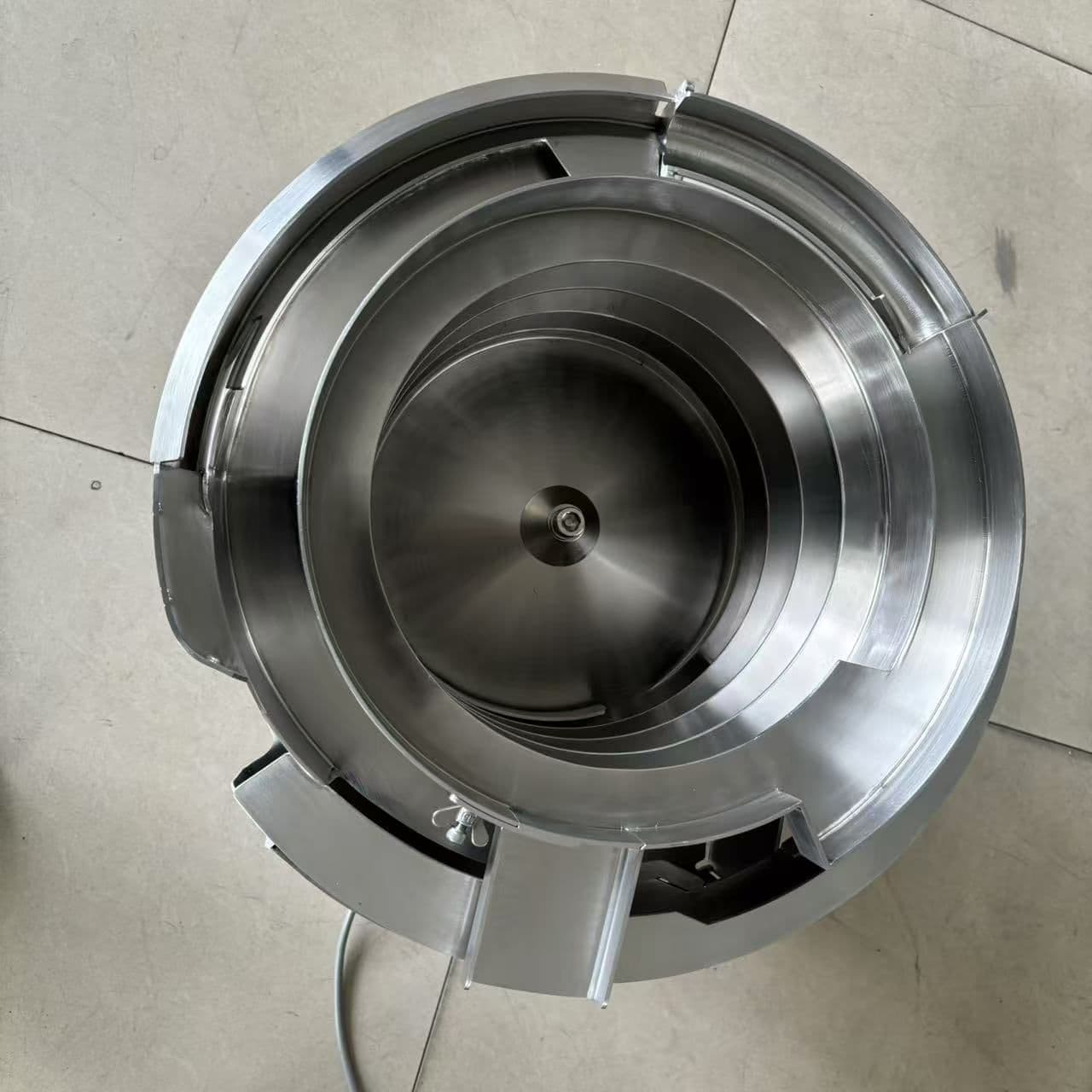
What a 304 stainless steel vibratory bowl feeder actually is
A vibratory bowl feeder is a parts-orienting machine, not a conveyor. A bowl-shaped hopper holds a bulk load of small parts, an electromagnetic or motorised drive shakes the bowl in a controlled cycle, and a helical track cut or bolted inside the bowl lifts parts upward while rejecting the wrong orientations. Only correctly oriented parts reach the outfeed, where a downstream machine, pick-and-place head, or assembly station takes them.
The product family described here combines three choices that buyers should evaluate separately: a 304 stainless steel bowl and contact surfaces, a variable speed controller that adjusts drive output, and a custom bowl tooling package built around a specific part. Each choice carries its own decision criteria and its own failure modes. Treating them as one specification is the most common buying error.
Scope note: the descriptions supplied for this product line cover bottle-cap feeding, PCB component feeding, and general small metal part feeding. The technical points below apply to that class of equipment; exact amplitudes, feed rates, bowl diameters, and drive ratings must come from the supplier's datasheet for the specific unit, because they vary with bowl size, part mass, and tooling.
How the drive and bowl work together
Electromagnetic drive mechanism
In an electromagnetic bowl feeder, an electromagnet pulls an armature mounted to the bowl base, and leaf springs or a spring pack return the bowl. Energising the coil at mains frequency produces a torsional vibration that drives parts up the helical track. Because the drive is resonant, the spring pack and the bowl mass form a tuned system: the feeder performs best near its design frequency, and performance falls off when the bowl load or tooling changes the tuned mass.
This matters for procurement because a feeder quoted for one part and one bowl load is not automatically suitable for a heavier part or a larger bowl. Ask the supplier to state the drive rating and the bowl mass the drive was tuned for, and confirm what happens if your part mass or bulk load changes.
Bowl tooling and orientation
The bowl is the tooling. Orientation is achieved by features inside the bowl: track width, wipers, air jets, cut-outs, and shaped pockets that let a part fall back unless it sits correctly. Tooling quality decides yield, not the drive. A feeder with a strong drive and poor tooling will recirculate parts and starve the downstream station.
For small parts, track width and pocket depth become the critical dimensions. Thin-walled, asymmetric, or easily tangled parts are the hardest cases, and they are the ones most likely to need a trial before purchase rather than a catalogue selection.
What the variable speed controller changes, and what it does not
A variable speed controller adjusts drive output, which changes the vibration amplitude and therefore the average feed rate. In practice it is a tuning and balancing tool, not a throughput upgrade. Raising output increases speed up to a point; beyond that, parts bounce, lose orientation, or recirculate, and the effective feed rate falls.
Buyers should confirm three things about the controller:
- Control range and resolution. A wide range is useful for matching the feeder to downstream cycle time, but the usable band for a given part is usually narrow. Ask what range the supplier recommends for your part.
- Stability under load. Feed rate should hold when the bowl load drops from full to nearly empty. If the supplier cannot describe how the drive behaves across the load range, request a demonstration.
- Integration. Confirm the controller's input voltage, signal interface for start/stop and speed setpoint from a PLC, and whether it can be mounted remotely from the bowl.
Do not assume a controller compensates for weak tooling. Speed control adjusts how fast parts move; it does not fix orientation.
Why 304 stainless steel, and where it stops being the right choice
304 stainless steel is a common choice for bowl feeders in food, beverage, personal care, and general assembly because it resists corrosion in normal washdown and humid environments and is easy to clean. The supplied product description positions the bottle-cap feeder for food, beverage, and personal care lines, which is consistent with that material choice.
It is not a universal answer. Buyers should raise the following with the supplier rather than assume:
- Aggressive chemistry. Chloride-rich or strongly acidic environments can attack 304. If your washdown chemicals are aggressive, ask whether a higher-alloy grade is available and what the supplier recommends.
- Abrasive parts. Hard, sharp parts can wear track surfaces. Ask about track material and replaceable wear sections.
- Cleanroom and electronics. For PCB component feeding, particle generation and static are the concerns; confirm surface finish and any grounding provisions.
Comparison: what to evaluate across feeder configurations
| Decision factor | Bottle-cap feeder | Small-parts / PCB feeder | What to ask the supplier |
|---|---|---|---|
| Part geometry risk | Caps are light and stack or nest easily | Components are small, light, and orientation-sensitive | Which orientation features are used, and how are wrong orientations rejected? |
| Drive type | Electromagnetic drive with speed controller | Electromagnetic drive with helical track | Drive rating, tuning, and behaviour at partial bowl load |
| Contact material | 304 stainless steel | 304 stainless steel | Surface finish, cleanability, and wear-part replacement |
| Throughput claim | High-speed feeding | High-speed feeding with precise separation | Feed rate measured on your part, at what bowl load, with what reject rate |
| Customisation | Custom bowl for cap size and line | Factory-customised bowl for the component | What sample quantity and drawings are needed, and who approves the trial result |
The table is a question list, not a specification. The numbers that decide the purchase are the ones produced on your parts.
Verification: how to test a feeder before committing
The single most useful procurement step is a part trial on the actual bowl tooling, using a representative sample of your parts. A trial should produce measurable evidence, not a video of parts moving.
What a credible trial report contains
- Sample definition. Part drawing or key dimensions, material, mass, and the sample quantity used.
- Feed rate. Parts per minute at the outfeed, measured over a stated interval, at a stated controller setting and bowl load.
- Orientation yield. The proportion of parts that reach the outfeed correctly oriented, and how rejects are handled.
- Stability. Feed rate at full bowl and near-empty bowl, to show whether the drive holds speed as load changes.
- Failure notes. Where parts jam, tangle, or double-feed, and what tooling change was made.
If a trial is not possible before order, ask for the acceptance criteria in writing and for the procedure used to tune the bowl on arrival. A feeder that cannot be tuned on site to meet the agreed rate is a commissioning risk, not a bargain.
Common failure modes and what they tell you about the specification
Most feeder problems trace back to a mismatch between the part, the tooling, and the drive, not to a defective component.
- Recirculation without outfeed. Tooling rejects too aggressively or the track is too narrow. Symptom: parts move but the outfeed starves.
- Double-feeding and jams. Track or pocket dimensions are marginal for the part tolerance. Ask how part tolerance spread was accounted for in the tooling design.
- Speed drift as the bowl empties. The drive is tuned for a full load, or the controller lacks adequate regulation. Confirm the load range the feeder was tuned for.
- Surface wear on the track. Abrasive parts and soft track material. Ask about replaceable wear parts and their lead time.
- Noise and loosening. Loose spring packs or mounting. Confirm mounting requirements and the maintenance interval for fasteners.
For each failure mode, the purchasing response is the same: convert it into a written question and a trial measurement.
Specification checklist for the enquiry
Send the supplier a package rather than a sentence. A complete enquiry shortens the quotation cycle and reduces the chance of a bowl that cannot be retooled.
- Part drawing with tolerances, material, mass, and a photo of the part in bulk.
- Required feed rate in parts per minute, and the downstream machine's cycle time.
- Required orientation at the outfeed, with a sketch.
- Bowl load and refill method, and whether the bowl runs continuously or intermittently.
- Environment: washdown chemicals, humidity, cleanroom class, static sensitivity.
- Controller interface: voltage, PLC signals, mounting location.
- Acceptance criteria and the trial or commissioning procedure.
- Spare and wear-part list, and the maintenance access requirements.
The supplier's answers to these items are the real specification. Catalogue language such as "high-speed" or "precise" is only meaningful once it is tied to your part, your rate, and a measured trial.