
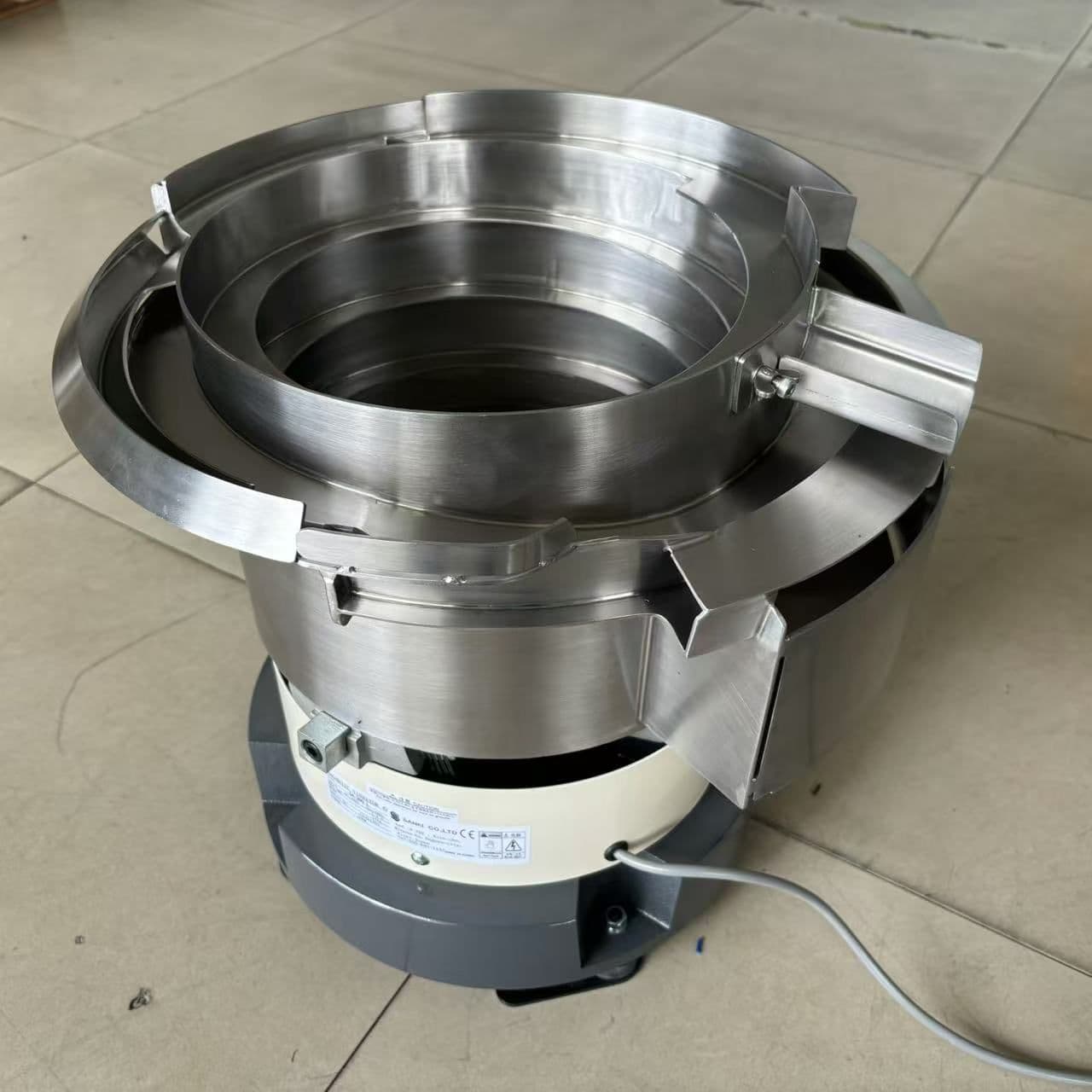
What you are actually buying
A vibratory bowl feeder is a parts-orienting machine, not a catalog item. The bowl, drive base, and controller form one tuned system, and the system is built around one part geometry. That is why two feeders with the same bowl diameter can behave completely differently on the same screw, cap, or connector.
In the product listings referenced for this guide, the offering is a 304 stainless steel bowl feeder with a variable speed controller, described as customizable and intended for small parts and bottle caps. Treat those as starting points for a specification conversation, not as a finished specification. The buyer's job is to convert a part drawing into a feeder requirement the supplier can quote against and you can test.
Three components matter:
- The bowl and tooling. The track, orienting features, and discharge are cut or built to present the part in one attitude. 304 stainless steel is the stated bowl material; confirm whether it is the bowl shell only or also the track and tooling, since that affects wear and cleanability.
- The drive base. The electromagnetic or motorized base converts controller output into vibration. Bowl and base are matched; a bowl swap usually requires re-tuning.
- The variable speed controller. It sets feed rate by adjusting drive output. Ask what the adjustment range covers in practice and whether rate can be set low enough for your downstream cycle without stalling.
Prepare the part data before you request a quote
Most quoting delays come from the buyer's side. A feeder supplier cannot design orienting tooling from a photo. Assemble the following and send it with the inquiry:
- A 3D model (STEP or equivalent) and a 2D drawing with tolerances for the part.
- Material, surface finish, and any coating, plating, or magnetized condition.
- Weight per piece and the range of acceptable weight variation across production lots.
- Which features are fragile, which side must not be scratched, and which orientations are unacceptable downstream.
- Required orientation at discharge, plus any second orientation the downstream station can tolerate.
- Target feed rate in parts per minute, stated as a normal running rate and a peak rate, not a single number.
- Whether parts arrive bulk, tangled, oily, wet, or mixed with swarf or flash.
- Ambient conditions: washdown, coolant mist, dust, food-contact expectations, or cleanroom.
- Available floor or frame space, mounting height, and the interface to the next machine.
If the part is new and dimensions are still moving, say so. A feeder built to a prototype drawing may need retooling when the part changes, and it is cheaper to agree on that risk in advance than to discover it at commissioning.
Decisions to lock down before comparing suppliers
Use this table to structure the specification conversation. The right-hand column is what you should ask each supplier to state in writing.
| Decision | Why it matters | Evidence to request |
|---|---|---|
| Bowl material and contact surfaces | 304 stainless is the stated material; wear life and cleaning depend on where it is used | Material callout for bowl shell, track, and tooling; surface finish; whether non-stainless parts touch the product |
| Orienting method | Determines yield, jam rate, and how much rework a part change causes | Description or drawing of orienting features; expected reject/recycle rate for your part |
| Drive type and size | Sets achievable rate, noise, and sensitivity to part weight variation | Drive type, rated output, and the bowl diameter it is matched to |
| Controller and speed range | Variable speed is only useful if the low end is stable and the high end is reachable | Controller model, input voltage, adjustment method, and demonstrated rate at low, mid, and high settings |
| Discharge and interface | Feeder performance collapses if the handoff to the next machine is mismatched | Discharge height, track width, sensor or escapement provisions, and interface drawing |
| Changeover and cleaning | Affects downtime if you run more than one part | Time and tools needed to swap bowls or clean; access to track and bowl interior |
| Documentation | Needed for maintenance, spares, and audit | Wiring diagram, controller manual, spare-parts list, and tuning instructions |
Two of these deserve extra attention. First, the speed controller: a variable-speed drive that only works in the top half of its range is a single-speed feeder with extra hardware. Second, the discharge interface: ask for the height and orientation of the part as it leaves the track, because that is the dimension your downstream tooling must meet.
Where the trade-offs actually sit
Stainless steel versus other bowl materials
304 stainless steel is a reasonable default for general industrial parts and for environments where corrosion resistance and washdown matter. It is not automatically the best choice for every part. Abrasive parts wear tooling faster regardless of bowl shell material, and soft or polished parts can be marked by bare metal contact. If surface damage is a concern, ask whether the supplier can line or coat contact surfaces, and confirm how that changes the track dimensions.
Custom bowl versus standard bowl
A custom bowl is justified when the part has a specific orientation requirement, a difficult aspect ratio, or a downstream station that accepts only one attitude. A standard bowl with simple tooling can be adequate for parts that self-orient easily. Custom tooling raises the initial cost and ties the feeder to that part; if your part family changes often, ask what a bowl change would cost and how long it takes before you commit.
Feed rate versus stability
Higher amplitude and speed generally raise throughput but also raise noise, wear, and the chance that parts bounce out of orientation. For small or light parts, the practical ceiling is often set by how gently the part can be moved, not by drive power. Specify the rate you need at the downstream station and let the supplier propose the margin; do not ask for the maximum rate the bowl can reach.
Single feeder versus a feeding line
If parts must be separated, counted, or presented in a fixed pitch, the bowl is one element of a line that may include a linear track, escapement, or vision check. Decide early whether those elements are in scope, because the bowl discharge is designed around them.
How to validate before you place a production order
Ask for a demonstration on your actual parts, not on the supplier's sample parts. A useful validation covers:
- Orientation yield. Run a known quantity and record how many parts arrive correctly oriented versus recirculated or rejected.
- Rate stability. Measure parts per minute at the low, middle, and high controller settings, over a run long enough to expose drift.
- Jam behavior. Deliberately introduce slightly out-of-spec parts and observe whether the feeder clears them or stops.
- Noise and vibration. Note sound level at the operating setting and whether the base needs isolation from the frame.
- Surface condition. Inspect parts after the run for scratches, dents, or coating transfer.
- Controller behavior. Confirm the adjustment method, the response to a speed change, and whether the setting holds after a power cycle.
Record the results against the specification table. If the supplier cannot demonstrate on your parts, ask what evidence they can provide instead, such as a video of a comparable part or a documented test report, and treat the gap as risk you are carrying.
Questions that separate a real supplier from a reseller
- Which parts of the feeder do you manufacture and which do you buy in?
- Who tunes the bowl to the drive base, and what happens if the tuning drifts after installation?
- What is the controller's adjustment range, and how is it set?
- What documentation ships with the unit, and in what language?
- What spare parts should we hold, and which wear items should we expect to replace?
- Can you supply a second bowl for a different part, and what is involved in swapping it?
- What is your process if the feeder does not reach the agreed rate at commissioning?
Answers that stay vague on tuning, documentation, or commissioning support are a warning sign. So is a quote that lists a bowl diameter and a price but no orienting method, no controller details, and no interface drawing.
Common specification mistakes
- Quoting from a photo. Without a 3D model and tolerances, the orienting tooling is guesswork.
- Specifying a rate with no margin. A feeder quoted at exactly your required rate has no headroom for part variation.
- Ignoring the handoff. The discharge height and part attitude must match the next machine, or the feeder is blamed for a downstream problem.
- Assuming stainless means maintenance-free. Tooling still wears, and cleaning access still matters.
- Buying for one part when you run five. If changeover is likely, raise it before the bowl is cut.
Next step
Write a one-page requirement sheet using the part data and decision table above, mark which items are fixed and which are open, and send it to two or three suppliers with a request for a demonstration on your parts. Compare the responses against the same sheet. The supplier that answers the interface, controller, and tuning questions specifically, and offers a test on your parts, is the one worth a production order.